

For over a billion Chinese people, no moment in the year carries more weight and warmth than the Lunar New Year Eve. It is a night of profound duality: a solemn farewell to the old year and a joyous welcome to the new, all centered around one powerful act—family reunion. This tradition finds its fullest expression in two iconic customs: the lavish Reunion Dinner and the exchange of Red Envelopes. Let's delve into their fascinating origins and enduring significance.
How did reunion dinner originate and develop?
As we know today, reunion dinner did not begin as a simple family meal. During the pre-Qin period(before 221 BCE), it was a solemn religious ritual. Its core purpose was to offer sacrifices to ancestors and deities (such as the Kitchen God and the Door God) on the last day of the lunar year. This was done to give thanks for their protection over the past year and to pray for favorable weather and bountiful harvests in the coming one. After the ceremony, family members would share the sacrificial food, which can be seen as the origin of the communal feast.
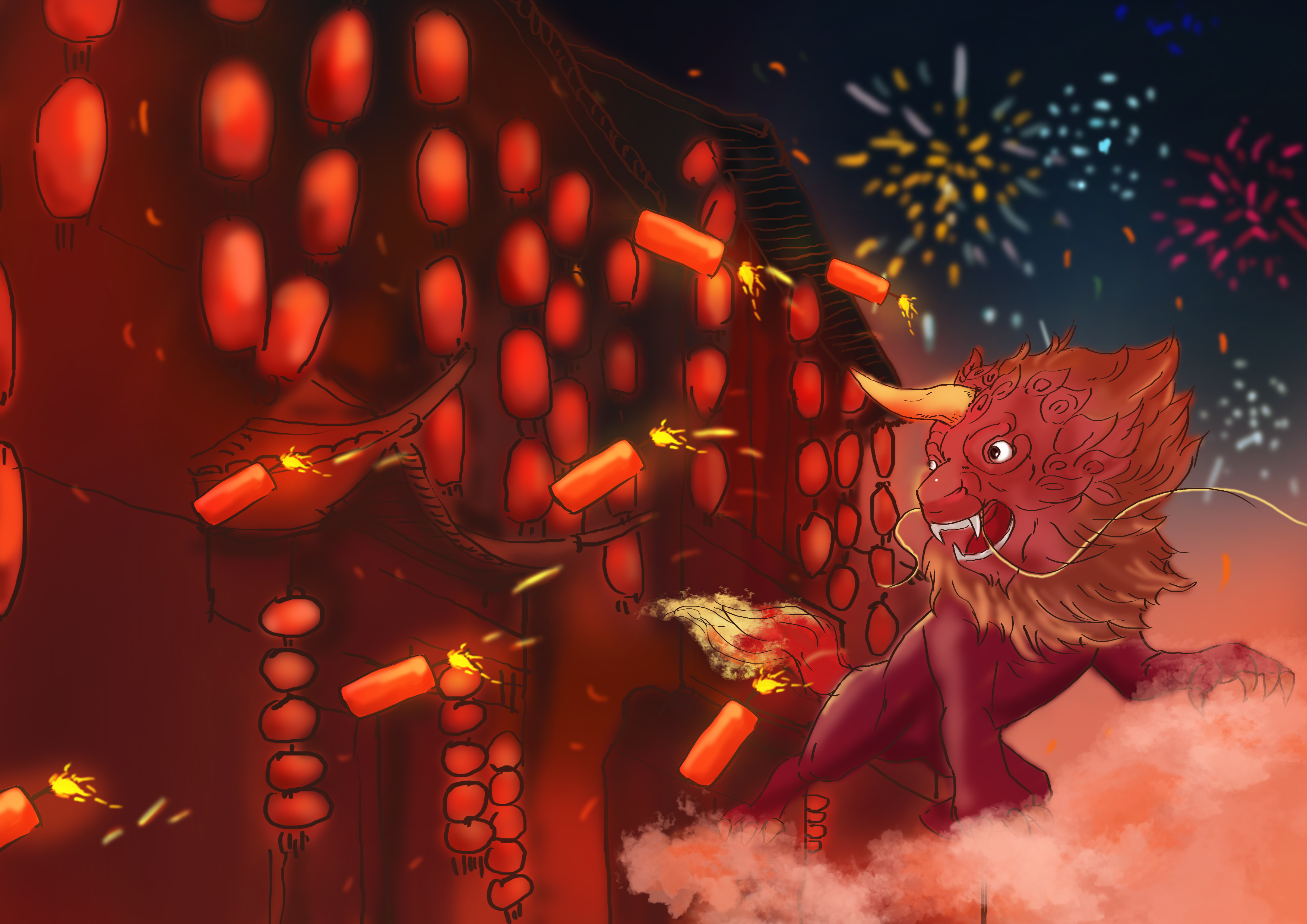
This tradition is also intertwined with the legend of “nián”(年), a mythical ferocious beast believed to emerge on New Year’s Eve to harm people. Discovering that Nian feared the color red, firelight, and loud noises, people began staying up all night on New Year’s Eve— gathering for a hearty meal to boost their courage, and using red decorations and firecrackers to ward off evil. This shared meal served as an early prototype of the New Year reunion dinner, carrying strong connotations of folk magic and communal survival.
By the Han Dynasty, Confucian values like filial piety profoundly shaped the celebration. New Year's Eve became the paramount occasion for family unity. The rituals of ancestral worship, the gathering of the extended family, and the shared feast became inseparable, establishing "family reunion" as the dinner's eternal theme for the next 2,000 years.
With social and economic development during the Tang and Song dynasties, the New Year reunion dinner gradually transformed into a more abundant secular celebration. The dishes became increasingly lavish, and foods symbolizing good fortune became a fixed part of the feast. The custom of "Shou Sui" (staying up late on New Year's Eve) became closely integrated with the dinner, making all-night feasting and entertainment a popular tradition. The practice of giving Yasui Qian(压岁钱) gained popularity in both imperial courts and among common people. New Year decorations like Spring Festival couplets and New Year paintings also emerged, creating a complete festive atmosphere.
By the Ming and Qing dynasties, most of the New Year reunion dinner customs we recognize today had become fully established, as recorded in local chronicles and folk notes. Due to China's vast territory and diverse local produce, the dinner's menu developed distinct regional variations, giving rise to unique local flavors.
In modern times, despite faster-paced lifestyles, returning home for the New Year reunion dinner remains one of the deepest emotional imperatives for the Chinese people. While the Spring Festival Gala on television has become a new electronic backdrop, the core themes of family reunion, auspiciousness, and blessing have never changed.

The reunion dinner, known as Nian Ye Fan, is held on Chuxi, the final night of the lunar year. While Chuxi typically falls on the 30th day of the 12th lunar month, a notable calendrical variation will occur from 2026 to 2029, when it will occur on the 29th day for four consecutive years. For instance, the upcoming Year of the Horse begins on February 17, 2026, with its New Year's Eve falling on February 16—corresponding to that year's 29th day of the 12th lunar month. After this relatively rare sequence, the frequency of Chuxi occurring on the 30th day will return to its usual pattern.
Do Families in Hunan Have Their New Year Reunion Dinner Before the Actual Eve?
This custom is not a common custom across the entire province of Hunan but is primarily observed in the Xiangxi Tujia and Miao Autonomous Prefecture. Most Tujia families there hold their grand reunion dinner one day earlier than thenot common throughout Hunan Province, but is primarily observed in the Xiangxi Tujia and Miao Autonomous Prefecture. There, most Tujia families hold their grand reunion dinner a day earlier than the traditional Chinese celebration on Lunar New Year’s Eve.
The essence of the custom, captured in the word "赶" (meaning "to rush"), is to start the feast before dusk on the day prior. This tradition has dual roots: it stems from ancient historical practices of guarding borders and preparing for battle, and carries the folk belief that eating the meal early welcomes good fortune early.
A popular legend traces the custom to the Ming Dynasty, when soldiers from the Tujia and Miao ethnic groups in western Hunan were recruited to resist Japanese pirates (known as “Wokou”) along the coast. To allow these troops a family reunion before deployment, their families are said to have advanced the feast to the 29th day or even early morning of the 30th. This aligns with the historical need for early meals and equipment preparation in border communities, reflecting the Tujia people’s bravery, unity, and collective spirit.
Known as Ganian(Celebrating the New Year in Advance), this tradition is a distinctive cultural heritage of the Tujia people. It illustrates the rich diversity within China’s nationwide Spring Festival celebrations, where the universal theme of family reunion finds unique local expressions shaped by history and community values.
How Many Dishes Are Typically Served For The Lunar New Year Reunion Dinner?
The reunion dinner is considered the most important family meal of the year in China. It is essential for all family members to gather. If someone cannot return home, a place is still set for them, with a bowl and chopsticks. Seating follows a specific order, honoring the elderly and caring for the young, reflecting traditional etiquette. This grand feast marks both the end of the old year and the beginning of the new, serving as a reward for the year's hard work and an expression of hope for future abundance.
Regarding the number of dishes, there is no fixed rule. However, a common principle is to prepare dishes in even numbers, as these symbolize good fortune and harmony in Chinese culture. The specific number carries symbolic meaning:
- 6 dishes: Symbolize smooth progress in all matters,
- 8 dishes: The number eight is homophonous with "prosperity" ("fā") in Chinese, representing wealth and great fortune.
- 10 dishes: Represent perfection.
- 12 or more dishes: Symbolize abundance and monthly prosperity, suitable for large family gatherings.

The number four is widely considered unlucky and often avoided in Chinese culture because its pronunciation is similar to the word for “death.” Additionally, the number seven may also be viewed as inauspicious in some regions, such as Guangdong, where it carries negative connotations in Cantonese, and is thus sometimes avoided in specific settings.
The final number of dishes is ultimately decided flexibly based on family size, personal tastes, and dietary habits. Customs also vary by region. For instance, in Guangdong, a common standard is "eight dishes with one soup," while ten dishes with one soup is considered perfect. In Shanghai, traditions were historically more lavish, featuring elaborate spreads like "eight cold appetizers and eight hot stir-fried dishes," plus soup and desserts.
What Do Chinese People Usually Eat for the Lunar New Year Reunion Dinner?
Think of the New Year's Eve feast as a "Banquet of Wishes." Every dish is chosen not just for taste, but for the auspicious blessing its name symbolizes.

A whole chicken is a must, as its Chinese name (鸡 jī) sounds like the word for "auspicious" (吉 jí), wishing good luck for all. Hair moss (发菜 fàcài) and lettuce are popular because their names sound like "strike it rich" and "generate wealth," respectively. Letture is often simply stir-fried with oyster sauce, creating the dish "Haoyou Shengcai"—a clever pun meaning "good at generating wealth." Dried tofu sticks (腐竹 fǔzhú) symbolize "affluence" (as the sound resembles “富足”), while garlic (蒜 suàn) represents the wisdom of being good at "calculations" and managing finances.
Rice cake (年糕 niángāo), made of glutinous rice, symbolizes a wish for "promotion and progress every year" (as "gāo" means "high"). Eating it expresses hope for continual improvement. A whole fish is essential but is never finished completely, embodying the phrase "nián nián yǒu yú" (年年有余), which expresses the wish for abundance and surplus year after year.

In northern China, dumplings (饺子 jiǎozi) are a must. Shaped like ancient gold ingots, they symbolize wealth and prosperity. Their name is also associated with the turning point between the old year and the new, making them a delicious way to “bid farewell to the past and welcome the future.” Families often hide coins or candies inside—finding one in your dumpling is believed to bring extra luck in the coming year.
In southern China, the highlight is sweet glutinous rice balls (汤圆 tāngyuán), especially during the Lantern Festival. Their round, full shape represents family reunion and wholeness, carrying wishes for harmony and a sweet, happy life.
Do Chinese Families Eat the Same Dishes for the New Year Reunion Dinner?
No, this feast is far from uniform across the country. China's vast territory and diverse cultures have shaped strikingly different versions of this meal in various regions.
Region |
Flavor Profile |
Signature Dish & Meaning |
South China (e.g., Guangdon) |
Freshness, tenderness, and clean flavors, highlighting natural taste. |
White Cut Chicken being a classic—renowned,Braised Pork Trotter with Hair Moss represent "striking it rich with ease" (发财就手fācái jiùshǒu), as their names are auspicious homophones. |
Southwest (e.g., Sichuan) |
Numbing spice, boldness, and complex layered flavors. |
Spicy Blood and Tripe Hot Pot (毛血旺Máo Xuè Wàng) features a bubbling, crimson broth brimming with silky duck blood, springy tripe, and an assortment of meats and vegetables. Its intense mala (numbing-and-spicy) flavor directly signifies a fiery, vibrant, and prosperous life. |
Central China (e.g., Hunan) |
Aromatic heat, savory, and robust tastes. |
Steamed Assorted Preserved Meats is a hallmark dish where bacon, cured fish, and sausages steam together, allowing their savory, sweet, and wine-infused aromas to intermingle—a delicious metaphor for "family harmony brings prosperity. |
East China (e.g., Jiangsu/Zhejiang) |
Savory-sweet balance, refined and elaborate preparation. |
A Jiangsu specialty is Egg Dumplings, shaped like gold ingots to represent wealth. Their golden, tender wrappers encase juicy meat fillings. Water Celery, prized for its crisp texture and unique fragrance, is eaten as its name sounds like "everything goes smoothly" (路路通lù lù tōng). |
North & Northeast China (e.g., Beijing/Shandong) |
Hearty, substantial, and focused on a bustling communal atmosphere. |
Beijing families often gather around a brass hot pot for Instant-Boiled Mutton(涮羊肉"Shuan Yangrou"), cooking thin lamb slices and dipping them in rich sesame sauc communal ritual that embodies family reunion and a prosperous, fiery life. In Shandong, artistically shaped "Huā Bōbo" (Steamed Flower Buns) take center stage; the act of steaming them symbolizes rising fortunes, while their firm-yet-soft texture carries the natural sweetness of wheat. |
From south to north, the ingredients, flavors, and signature dishes of this dinner vary dramatically, deeply influenced by local geography, climate, and history. Yet, they all converge on the same universal wishes: for family unity, good fortune, and a sweet year ahead. This beautiful concept of "harmony in diversity" is precisely what makes the culture of Chinese New Year so captivating.
Beyond the Feast: How Do Chinese People Celebrate New Year's Eve?
New Year's Eve, the final day of the lunar year, is marked by a series of interconnected, symbolic rituals centered on bidding farewell to the old, welcoming the new, and praying for good fortune.
During the day, homes come alive with the sounds of the "Annual Clean" (扫尘,sǎo chén). This isn't just any cleaning; it's a final, thorough sweep to literally and figuratively clear out the old. The practice gets its meaning from a play on words: the Chinese word for "dust" (尘, chén) sounds like the word for "old" or "stagnant" (陈, chén). The idea is to sweep away any lingering misfortune from the past year. There's a catch, though: all cleaning must be wrapped up before dusk. Once evening falls, taking out the trash or mopping the floor is avoided—you wouldn't want to accidentally "sweep away" the good fortune you've just made room for.

Next comes a refreshing family ritual. Everyone bathes and puts on a set of brand-new clothes. More than a simple refresh, this act symbolizes washing off the weariness and troubles of the past twelve months. It's about stepping into the New Year physically and mentally renewed, ready for a fresh start.
Posting New Year's Red Decorations (贴年红,tiē niánhóng) is the most important ritual in the afternoon. Brand new red Spring Festival couplets (chūnlián, 春联) with poetic, parallel verses are pasted on doorframes. Many families also adorn their main doors with Door God paintings (门神,ménshén) of historical warrior figures, believed to ward off evil. The character “福” (fú, meaning blessing) is often pasted upside-down, as the word for “upside-down” (倒,dào) sounds like “to arrive” (到,dào), symbolizing that “blessings have arrived.” Windows are decorated with paper-cuts , and red lanterns are hung, transforming the home into a world of auspicious red.

Before the reunion dinner begins, many families hold a solemn ancestor worship ceremony. An altar is set up in the ancestral hall or at home, laden with offerings of food, wine, and snacks, accompanied by lit incense and candles. Led by the elders, the family pays respects in turn, inviting ancestors home to "reunite." This practice embodies the traditional Chinese value of "honoring the past and remembering one's roots" and serves as a profound spiritual prelude to the family feast.
The New Year reunion dinner is the absolute centerpiece of the celebration, with customs extending far beyond a lavish meal. Seating arrangements follow a distinct order of seniority and respect. During or after the feast, elders give younger family members lucky money in red envelopes (hóngbāo, 红包) to bless the children with safety and health in the coming year. Today, sending digital red envelopes via apps like WeChat has also become commonplace.

Following the meal comes the tradition of “shǒusuì” (守岁), where the whole family stays awake together to welcome the New Year. Nowadays, gathering to watch the Spring Festival Gala on television has become a central modern ritual of shǒusuì. It is customary to keep all lights on throughout the night, a practice known as “zhào xūhào” (照虚耗), symbolically driving away all darkness and loss for the year ahead.
At the stroke of midnight, households traditionally set off firecrackers to scare away the legendary Nian beast—this is called “kāimén pàozhàng” (开门炮仗, opening-door firecrackers). The head of the household then performs “kāi cáimén” (开财门), opening the main door to usher in the New Year's fortune. The most devout may hurry to temples to offer the first incense, praying to receive the year's very first blessings.

Each ritual of the Chinese New Year's Eve carries a simple philosophy of dispelling shadows and welcoming brightness. While their forms may evolve with time, their core essence—the commitment to family reunion, reverence for ancestors, and aspiration for a flourishing life—remains unchanged. It is precisely these time-honored rituals, passed down through generations, that infuse the celebration of observing the New Year with a force of warmth that transcends time, defining the uniquely Chinese cultural celebration of the New Year.
What Are the Taboos on New Year's Eve?
Chinese tradition holds that words possess powerful suggestive power. Therefore, on New Year's Eve, one must absolutely avoid uttering any inauspicious or negative words, such as "death," "ghost," "kill," "break," "gone," "poor," or "sick." If someone, especially a child, slips and says such a word, adults will immediately dismiss it by saying "tóng yán wú jì" (children's words bear no ill omen). If dishes or mirrors are accidentally broken, one must quickly say "suì suì píng ān" (a phrase where "sui" for "broken" sounds like "year," meaning "peace every year") or "luò dì kāi huā" (falling to the ground and blossoming), thus transforming misfortune into an auspicious blessing. Harmony should be maintained at home; arguments or scolding children are avoided to prevent disrupting the festive reunion atmosphere and offending the gods of joy.
Using sharp objects like knives, scissors, or needles is also taboo on this day, as their associations with "cutting" or "piercing" are feared to bring bad luck, such as financial loss or broken relationships. In Hong Kong, some believe that hanging laundry to dry on New Year's Eve might attract bad luck or "impure things," so this chore is typically avoided.
Furthermore, collecting or repaying debts is considered highly inauspicious. People strive to settle old accounts before the New Year, symbolizing not carrying burdens into the new cycle. It is also strongly discouraged to demand debt repayment from New Year's Eve through the fifth day of the New Year. During the ancestor worship ceremony, utmost respect must be shown.
These taboos, observed to safeguard the family's luck and harmony, collectively create a protected and purely positive space for welcoming a prosperous new beginning.
What Have Red Envelopes Been Like Throughout Chinese History?
In modern China, a red envelope ("hóngbāo") typically consists of crisp, new banknotes placed inside a red paper envelope decorated with auspicious patterns and phrases. The mandatory use of red stems from its deep cultural significance in Chinese tradition, symbolizing the warding off of evil spirits and the welcoming of good fortune and joy.

The earliest predecessors of red envelopes date back to the Han Dynasty, taking the form of charm coins or ornaments inscribed with auspicious phrases like "Peace Under Heaven" and adorned with dragon and phoenix patterns. These are the most iconic auspicious totems in Chinese culture, representing authority, supreme good fortune, harmony, and perfection. During the Tang Dynasty, the imperial court used elaborately crafted brocade pouches for gifts, while common folk began using red paper (symbolizing luck) to wrap handwritten notes of blessing for friends and family.
A popular form during the Qing Dynasty was the "Suisui Ping'an" (Peace Every Year) pouch or "Gift-of-the-Year pouch," often made of silk. These exquisitely embroidered pouches, called "Hébao," frequently featured patterns of quails, treasure vases, and wheat ears, symbolizing harmony, peace, and abundant harvests.

The red envelope gradually evolved into its more familiar modern form during the Republican Era. People began wrapping one hundred copper coins in red paper, symbolizing "a hundred years of longevity," which is considered the prototype of the modern paper red envelope.
Modern red envelope designs incorporate not only common characters like "Fu" (福, blessing) and "Cai" (财, wealth) but also the zodiac animal of the year. For the upcoming Year of the Horse, classic auspicious motifs like galloping horses, the "Eight Steeds," or horses treading on clouds are often featured on the envelopes.
Is "Yasui Qian" a Red Envelope?
Yes, "Yasui Qian" (压岁钱) is a specific type of red envelope. It typically contains a larger sum of money and is given primarily to children and unmarried members within a family, representing the elders' deep affection and blessings. Its core meaning lies in "Ya Sui" — to suppress "Sui," a mythical creature from folklore believed to harm children on New Year's Eve. The color red and coins were thought to ward it off. Therefore, parents would wrap money in red paper to protect their child's health, drive away misfortune, and convey good wishes for the new year.
Yasui Qian is specifically given around New Year's Eve and the first day of the lunar New Year. Some families distribute it during the reunion dinner, others immediately after the midnight bell, and some on New Year's Day after the younger generations have paid their respects.

The ritual follows a respectful order: the younger generation first extends New Year greetings to their elders, which may include a traditional bow or offering sincere well-wishes. In return, the elder presents the red envelope. To show respect, the recipient must accept it with both hands, offers sincere thanks on the spot, and returns blessings for the elder's health and longevity. The envelope is then placed respectfully aside and is never opened in front of the giver; it is opened later in private.
In contrast, a general Hongbao often contains a smaller amount of money, emphasizing "good intention" over "monetary value." They are commonly exchanged from New Year's Eve through the Lantern Festival (the 15th day of the first lunar month). Their scope is broader, often given to children of relatives and acquaintances, especially minors. It's common for parents to reciprocate by giving a red envelope of similar value to the other party's child.
How Much Money Inside a Red Envelope?
The amount given is typically an even number (e.g., 200, 600), symbolizing pairing and harmony, as good fortune is traditionally believed to come in pairs. People often select amounts that include digits considered especially auspicious, such as 6 (sounding like “flow,” symbolizing smooth progress), 8 (sounding like “wealth,” representing prosperity), and 9 (sounding like “long-lasting,” implying endurance and perpetuity). Common lucky amounts include 66 (“everything goes smoothly”), 88 (“wealth upon wealth”), and figures containing 9 like 99 or 199, to convey wishes for lasting happiness.
On the other hand, numbers deemed unlucky are generally avoided, most notably 4 (as its pronunciation resembles the word for “death”); in some regions, 3 and 7 may also be avoided according to local customs. Additionally, the bills themselves are preferably new and crisp. Old notes are seen as carrying past luck, while fresh ones symbolize renewed hopes and a bright beginning for the coming year. The bills themselves are preferably new and crisp. Old notes symbolize past luck, while new ones represent fresh hopes and a new beginning for the year.
The amount should be within the giver's means, as the sincerity behind the gesture is valued more than the monetary value. While physical red envelopes (symbolizing good luck) are traditional, digital forms like WeChat red packets are now very common. However, a hand-delivered envelope is still considered more formal and respectful. When elders give to multiple children of the same generation (e.g., nieces and nephews), the amounts are usually kept equal to prevent comparison among the children.
Yasui Qian Amounts in China
Region |
Typical Amount Range (per envelope) |
Notes |
Affluent Coastal Areas(e.g., Jiangsu, Zhejiang, Shanghai, Fujian) |
¥500 - ¥2,000, and often higer |
Reflects higher economic development levels. |
Southwest(e.g., Sichuan, Chongqing) |
¥200 - ¥800 |
Represents a moderate, common range. |
Cantonese-speaking Regions(e.g., Guangdong) |
¥100 - ¥500 |
Amounts are generally more modest, emphasizing blessing over value. |

In Northern China, for Yasui Qian given to close junior relatives (like grandchildren), one envelope is prepared per child. With popular sums being 500, 800, or 1,000 RMB. General Hongbao for visiting neighbors' children or distant relatives are smaller, typically 20 to 100 RMB, with 50 and 100 RMB being most common.
In Southern China, the practice of preparing one Yasui Qian per close junior relative is similar, but the amounts differ. General Hongbao here are given out more frequently for various social occasions (visits, workplaces, neighborhoods), with smaller amounts being the norm—5, 10, or 20 RMB based on the closeness of the relationship, and 50-100 RMB for closer ties.
Physical Specifications of Red Envelopes
Specification Type |
Designed Purpose |
Symbolism & Notes |
A flat 100-RMB bill Size |
Slightly larger than the note. |
The most common specification, carrying sincere wishes. |
Small Size |
Folded lower-denomination bills like 10 or 20 RMB. |
Used for symbolic, small-amount packets where the gesture of sharing good luck ("Caitou") is key. |
In Guangdong, red envelopes are specifically called "Lai See" (利是). This name originates from the authentic Cantonese blessing "Lei Lei Si Si" (利利是是), which means "everything smooth and successful." During the Spring Festival, married individuals are expected to prepare a large number of Lai See. Conversely, unmarried individuals can "dou lai see" (逗利是), meaning to playfully ask married people for this type luck money, usually by offering auspicious phrases in exchange for blessings. An amount like 50 RMB is considered quite substantial for a Lai See. While the monetary value may not be large, the true significance lies in the auspicious wish for "everything to go smoothly."
In China, giving red envelopes during the Spring Festival is primarily based on family ties or close social relationships, and there is no custom of exchanging them between strangers. However, there is a notable exception: in Cantonese-speaking regions like Guangdong and Hong Kong, it is common to give small Lai See to strangers. For instance, people might give them to security guards, servers, or landlords might give them to tenants. The amounts in these cases are typically very small, often just 5, 10, or 20 RMB, serving as a gesture of gratitude or to share the festive joy.
Ultimately, when preparing red envelopes, Chinese families base the amount on their financial means—the sincerity of the gesture is paramount. The essence of a red envelope is to act as a vessel for care and good wishes, not as a measure of social obligation. This tradition underscores that genuine affection is priceless, preserving the warm and purely well-wishing spirit at the heart of Chinese New Year culture.
Are red envelopes only given during the Spring Festival holiday?
Red envelopes is indeed a tradition specific to the Spring Festival. During this time, red envelopes are also given by younger generations to elders as a gesture of filial piety, respect, and blessings. These are often presented on other traditional occasions such as the Dragon Boat Festival, Mid-Autumn Festival, or elders’ birthdays, usually in the form of cash. The amount given typically equals or exceeds that of the previous year, symbolizing “adding fortune and longevity” to the elders. Beyond providing financial support—such as helping with daily expenses—these red envelopes serve as carriers of familial warmth, strengthening bonds among family members.
Red envelopes are not limited to the Spring Festival; they appear in many other contexts. At weddings, guests give red envelopes to the newlyweds as both a blessing for a happy marriage and a traditional form of congratulatory gift. For birthdays, housewarming parties, or newborn celebrations, red envelopes from friends and relatives convey “congratulations and good wishes.” During store opening ceremonies, partners or friends may present red envelopes to express hopes for “prosperous business and flourishing wealth.” In modern times, digital red envelopes (e.g., WeChat red packets) have become part of daily social interactions, often shared during festivals in small amounts for fun and festive cheer.
There is also the custom of opening red envelopes, typically given by employers to employees on the first workday after the Spring Festival holiday. Some companies may also offer small red envelopes to clients or partners who visit on that day, adding to the lively and auspicious atmosphere. This practice is especially popular in southern regions like Guangdong and Fujian and has gradually spread across various industries nationwide. The amount is usually modest, emphasizing good fortune rather than monetary value. On one hand, it conveys blessings for a smooth and healthy new year of work; on the other, it symbolizes the company’s prosperity and financial success in the coming year, using this small ritual to kickstart the new year’s work rhythm.
Festive Greetings and Well-Wishes
Spring Festival greetings are deeply rooted in traditional culture and family values, often featuring phrases such as “发财” meaning wealth and prosperity("fā cái"), “如意” meaning “may all your wishes come true("rú yì")
These well-wishes also frequently incorporate the zodiac animal of the year. As 2026 is a year of the Horse, greetings will highlight traits associated with the horse—such as vitality and success—through expressions like wishing you immediate success“马到成功(mǎ dào chéng gōng)” and wishing you vigorous energy and good health“龙马精神(lóng mǎ jīng shén)” .
Blessings When Giving Red Envelopes
1.Suitable for all:
Chinese Characters:阖家欢乐,万事胜意!
Meaning:Wishing you and your family happiness and all the best!
In Mandarin: héjiā huānlè, wànshì shèngyì/huh jyah hwahn luh, wahn shr shung yee/
In Cantonese: hap6 gaa1 fun1 lok6, maan6 si6 sing3 ji3
2.For children/teenagers:
Chinese Characters:健康快乐,学业进步!
Meaning:Wishing you health, happiness, and academic progress.
In Mandarin: jiànkāng kuàilè, xuéyè jìnbù/jyen kahng kwye luh, shweh yeh jeen boo/
In Cantonese: gin6 hong1 faai3 lok6, hok6 jip6 zeon3 bou6!
3.For adult younger generation:
Chinese Characters:工作顺利,步步高升!
Meaning:Wishing you success in your work and continuous promotion!
In Mandarin: gōngzuò shùnlì, bùbù gāoshēng/gong dzwaw shwun lee, boo boo gaow shung!/
In Cantonese: gung1 zok3 seon6 lei6, bou6 bou6 gou1 sing1
Replies When Receiving Red Envelopes
1.General Reply
Chinese Characters:谢谢!恭喜发财!
Meaning:Thank you, wishing you prosperity!
In Mandarin: xièxie! gōngxǐ fācái/syeh syeh! gong sshee faa tseye/
In Cantonese: do1 zeoi6! gung1 hei2 faat3 coi4
2.To Elders
Chinese Characters: 身体健康,万事如意!
Meaning: Wishing you good health and all the best!
In Mandarin: shēntǐ jiànkāng, wànshì rúyì/shun tee jyen kahng, wahn shr roo yee/
In Cantonese: san1 tai2 gin6 hong1, maan6 si6 jyu4 ji3
3.To Peers
Chinese Characters:新年快乐,笑口常开!
Meaning: Wishing you a happy New Year and endless smiles too!
In Mandarin:xīnnián kuàilè, xiàokǒu cháng kāi/sshin nyan kwye luh, ssyaow koh chahng kye/
In Cantonese: san1 nin4 faai3 lok6, siu3 hau2 soeng4 hoi1